
.jpg)
The rideshare environment is unlike any other advertising medium. With riders spending an average of 24 minutes in focused attention during their journey, Lyft offers advertisers a unique opportunity to capture undivided attention in ways that crowded social feeds or fleeting banner ads simply cannot match.
But this captive audience also demands a different creative approach. Generic display ads designed for other platforms often fall flat in the intimate, personal environment of a rideshare experience. That's why Lyft embarked on an ambitious data science project: analyzing nearly 1,000 unique display creatives to uncover what truly drives engagement on our platform.
The result? A comprehensive creative framework built not on assumptions or borrowed best practices, but on rigorous statistical analysis of real performance data. Here's what we discovered.

Clear direction and obvious value are the strongest predictors of ad success. Three clarity elements consistently boost engagement: explicit offers (+5.2% lift), clear call-to-action language (+2.9% lift), and prominent CTA buttons (+4.4% lift).
When combined, these elements create powerful synergy. The most successful ads in our dataset featured specific offers ("Claim Offer"), clear action words ("Buy Now”), and made these elements visually prominent with button design.
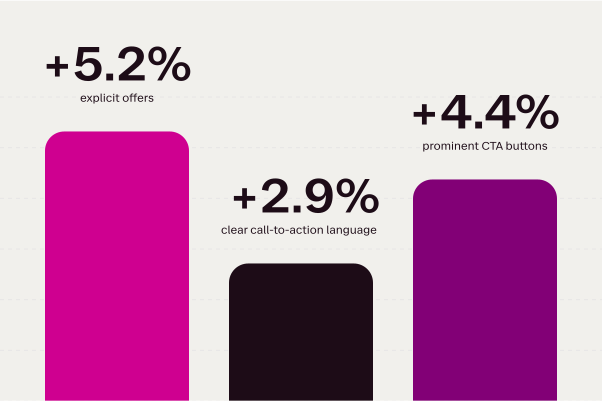

Rideshare passengers are often in transit to make purchases, dine out, or explore. They're already in a decision-making mindset, making clear direction and obvious value propositions especially effective during the focused 24-minute average journey.

Always combine three elements: (1) a specific offer or benefit, (2) a clear call-to-action, and (3) visual prominence through button design. This removes all friction from the decision-making process.

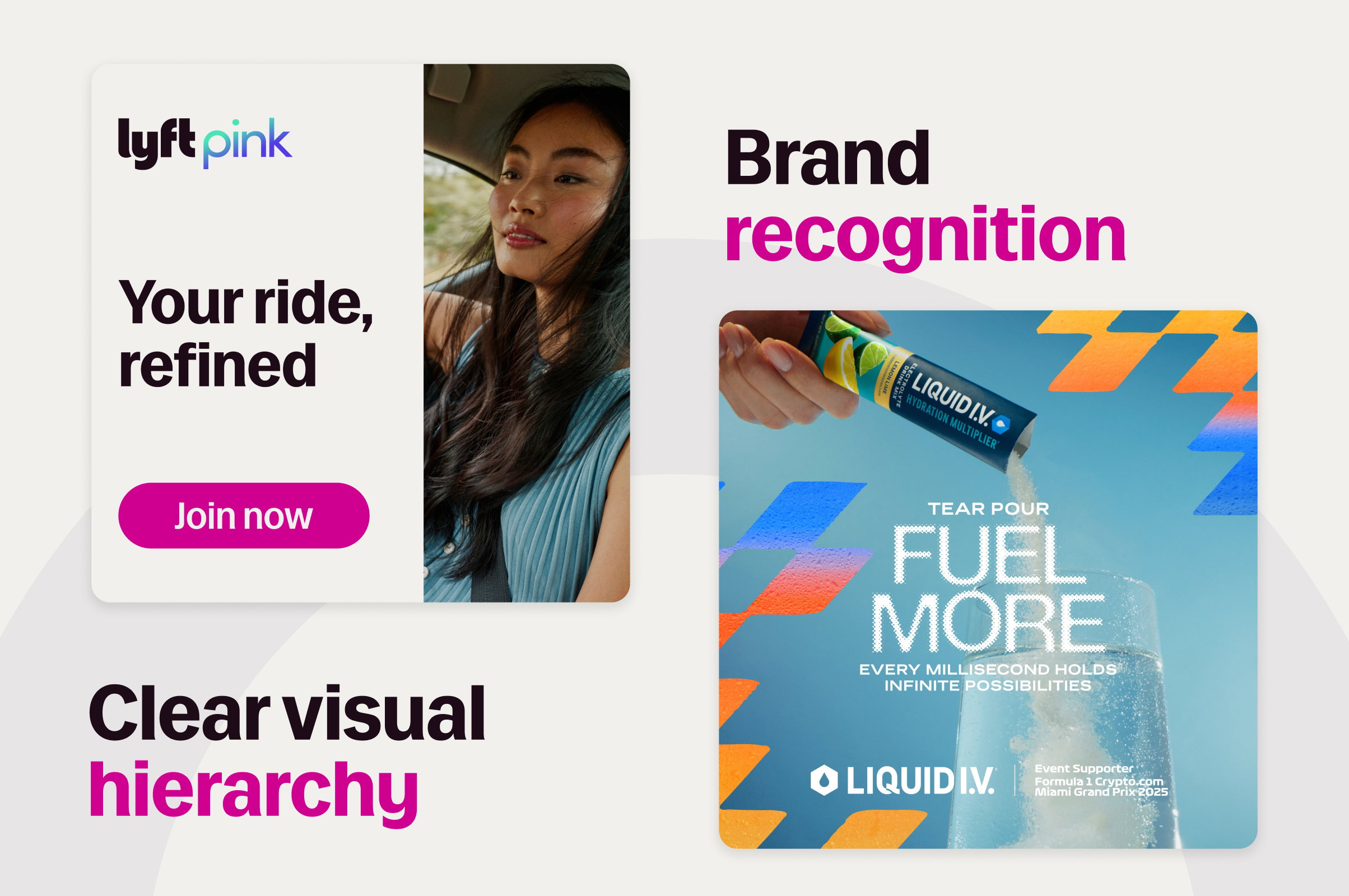
Including both logos and products significantly boosts performance—but creating clear visual hierarchy is crucial for maximum impact.
Our data shows that strategic brand element placement delivers substantial engagement lifts, with the most effective ads achieving 17-34% performance increases. The key insight: brand elements perform best when they support rather than compete with your primary message.

The most effective ads create a clear focal flow where brand elements reinforce trust and recognition while allowing main messaging to capture primary attention. When logos and products are positioned to complement rather than overshadow key content, they amplify overall ad effectiveness.
Always include recognizable brand elements, but position them to support your main message. Create a clear visual hierarchy where logos and products act as "supporting actors"—they reinforce trust and brand recognition while your primary offer or call-to-action takes center stage.
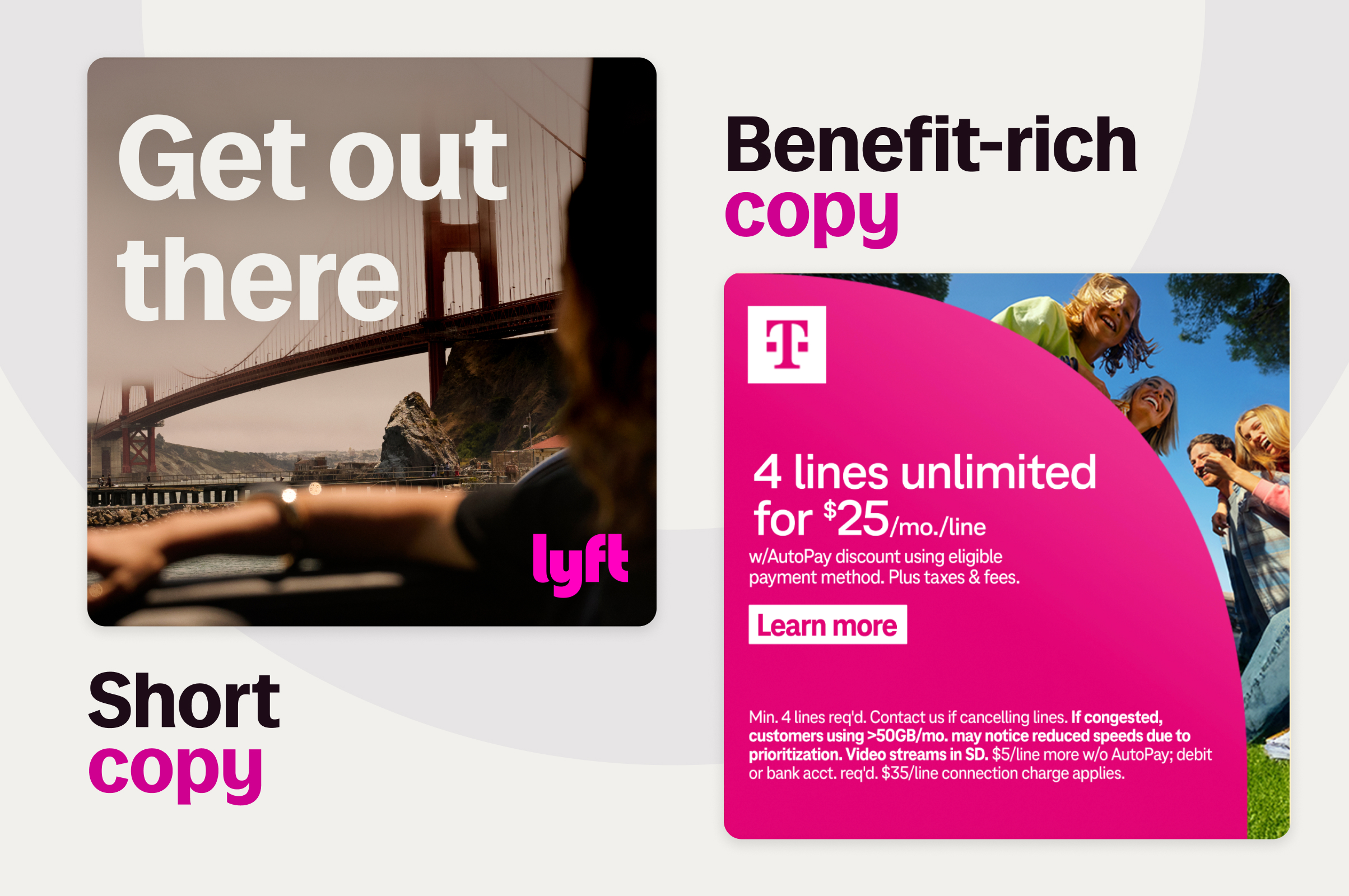
Ad performance follows a distinctive U-shaped curve with copy length—either minimal impact or comprehensive information, but never moderate length.
Our analysis revealed that ads with very short copy (0-1 words) and those with detailed, benefit-rich copy (7+ words) both significantly outperform moderate-length copy. The "middle ground" of 5-6 words consistently underperformed across all categories.

Short copy creates immediate visual impact and lets strong imagery drive engagement. Longer copy provides complete value propositions that riders can fully process during their journey. Middle-length copy achieves neither—too long for instant impact, too short for compelling detail.
Be decisive with your copy strategy. Either let compelling visuals do the heavy lifting with minimal text, or provide detailed, benefit-rich messaging. The focused rideshare environment gives you permission to be more comprehensive than other digital formats.
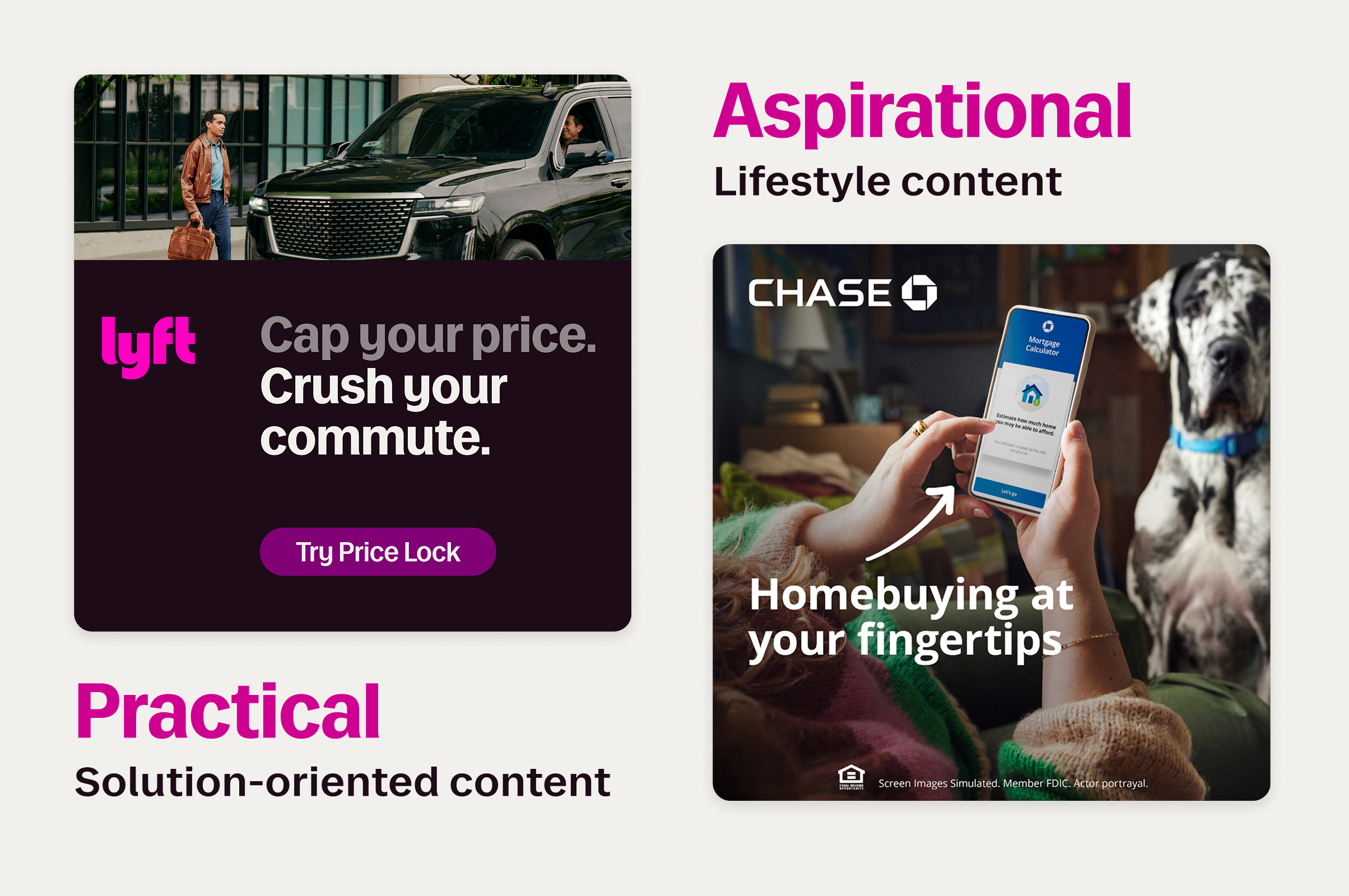
Ad performance varies dramatically by time of day and week, reflecting distinct rider mindsets and receptivity to different message types.
Morning commuters respond best to practical solutions—finance and telecom content seeing 25-30% lifts. Evening riders are more open to lifestyle and aspirational content. The most striking example: automotive ads perform poorly in the morning but strongly positive in the evening.

Weekend patterns amplify these trends. Finance ads (e.g., credit card offers) see a remarkable 42% lift on weekend evenings when riders have time to plan ahead, while health/wellness content spikes 56% on weekend mornings during relaxation-seeking moments.
Align your message with riders’ mindset. Target practical, solution-oriented content during morning commutes and aspirational, lifestyle content during evening periods. Weekend scheduling offers unique opportunities for future-planning and wellness-focused messaging.
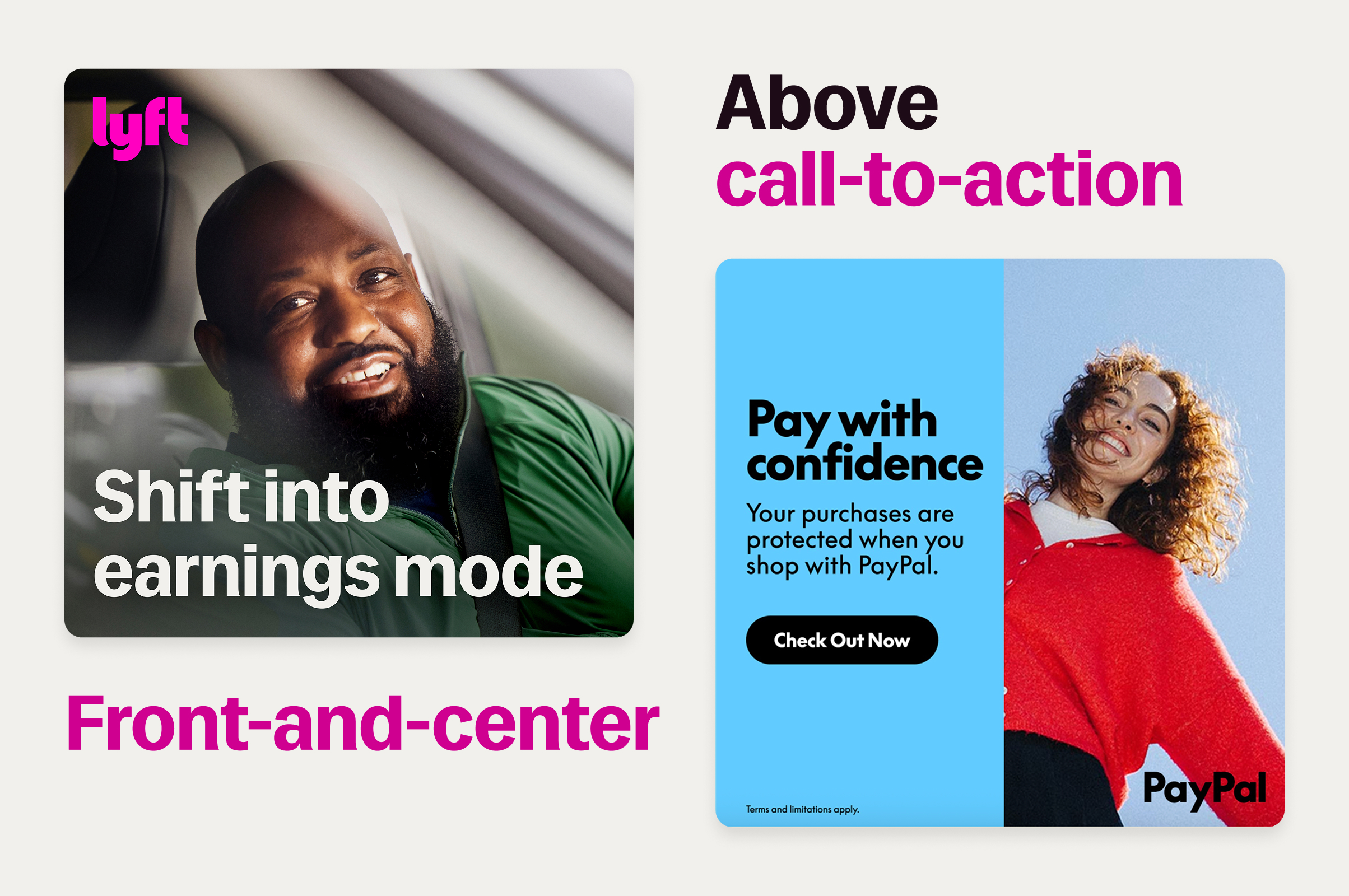
Human faces significantly boost engagement when placed strategically—with the most impactful position being lower-center (just above the call-to-action), delivering a 28% lift. Center placement also drives strong results with a 14% lift.
The key to maximizing face effectiveness is positioning: faces work best when the CTA is placed right underneath or alongside the face. This creates a natural visual flow from human connection to action.

The focused rideshare environment allows for genuine human connection that scattered-attention platforms cannot achieve. When faces are positioned to complement rather than compete with key messaging and CTAs, they build trust and encourage action.
Use authentic faces positioned to support your primary message—either front-and-center or just above your call-to-action. This creates trust-based connection while maintaining a clear visual hierarchy.
Ads with higher contrast and cooler color palettes (blues, greens, crisp whites) consistently outperform warmer, lower-contrast alternatives.
While the individual effect size is modest (+0.37% per unit of contrast increase), the statistical relationship is robust and consistent across different ad types within our dataset.

The in-car environment often features variable lighting conditions. High-contrast, cool-toned creatives remain visually striking and legible across different lighting scenarios, from bright daylight to dim evening rides.
Favor cool color palettes and boost contrast to ensure your key elements (faces, products, CTAs) stand out clearly in the unique in-car viewing environment.

The most successful ads in our analysis combined multiple elements strategically:
Our findings aren't based on simple comparisons or anecdotal observations. We used advanced regression analysis to examine nearly 1,000 unique display creatives, isolating the individual impact of each creative element while controlling for other variables.
This approach is crucial because creative elements often appear together. For example, an ad with a human face usually also has a clear call-to-action and prominent logo. Simple descriptive statistics would show that face-containing ads perform well, but couldn't tell us whether the face, the CTA, the logo, alone or in some specific combination drives performance.
Regression analysis examines each element's marginal effect—the isolated impact of adding a face, improving copy length, or repositioning a logo—while holding all other factors constant (such as industry, time of day, and day of the week). This gives us the confidence to recommend specific, high-impact changes rather than guessing which elements truly matter.
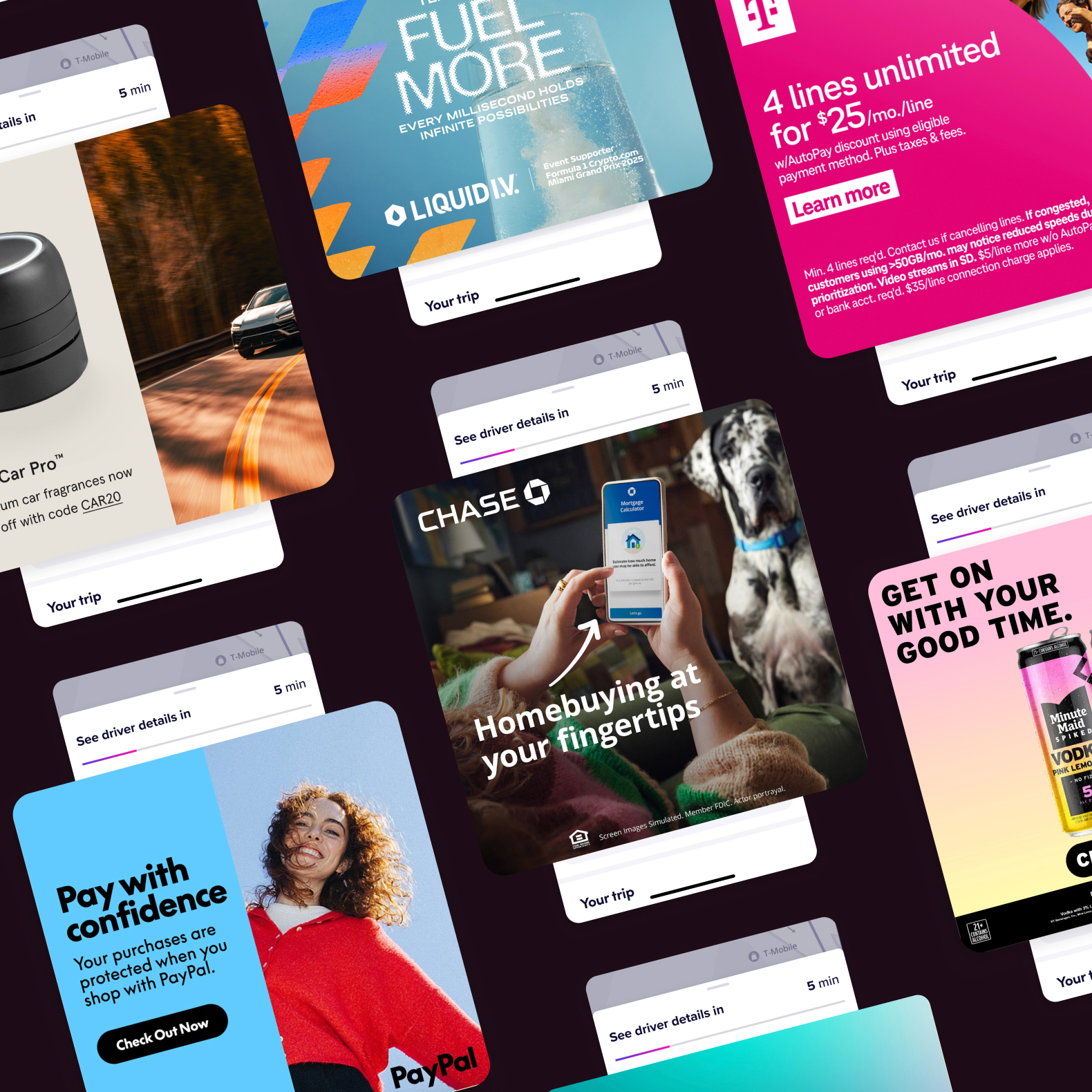
Our analysis included approximately 1,000 unique creatives from Lyft's advertising platform, with performance measured by click-through rates. To ensure data quality, we cleaned the data to remove outliers for a robust analysis.
This rigorous methodology ensures that every recommendation in this guide is backed by statistically significant evidence, not industry assumptions or borrowed best practices from other platforms. In addition, every recommendation was validated by a team of experts from sales, UI/UX, design and creative teams at Lyft.
.jpg)
This analysis represents our most comprehensive study of rideshare advertising effectiveness to date, but it's just the beginning. As the rideshare advertising landscape evolves, so too will our understanding of what drives engagement and conversion.
For advertisers, the key takeaway is clear: rideshare advertising requires a platform-specific approach.
The intimate, focused environment of a ride creates unique opportunities for connection and engagement—but only when creatives are designed specifically for this context.
The data doesn't lie: when brands apply these insights thoughtfully, they see measurable improvements in engagement and performance. In a world where every advertising dollar must work harder, that's the kind of competitive advantage that drives real business results.
Reach out to our team to access detailed creative guidelines, discuss your campaign strategy, and unlock the full potential of rideshare advertising.
Lyft Ads Studio: AJ Houk, Christina Yee, Will Eagle
Data Science: Francisco Mendes, Ravi Chandra Babu Ginjipalli, Aneesh Goel
Product Marketing: Shash Mehrotra, Jenny Liu
UX: Kat Murray

